 11
11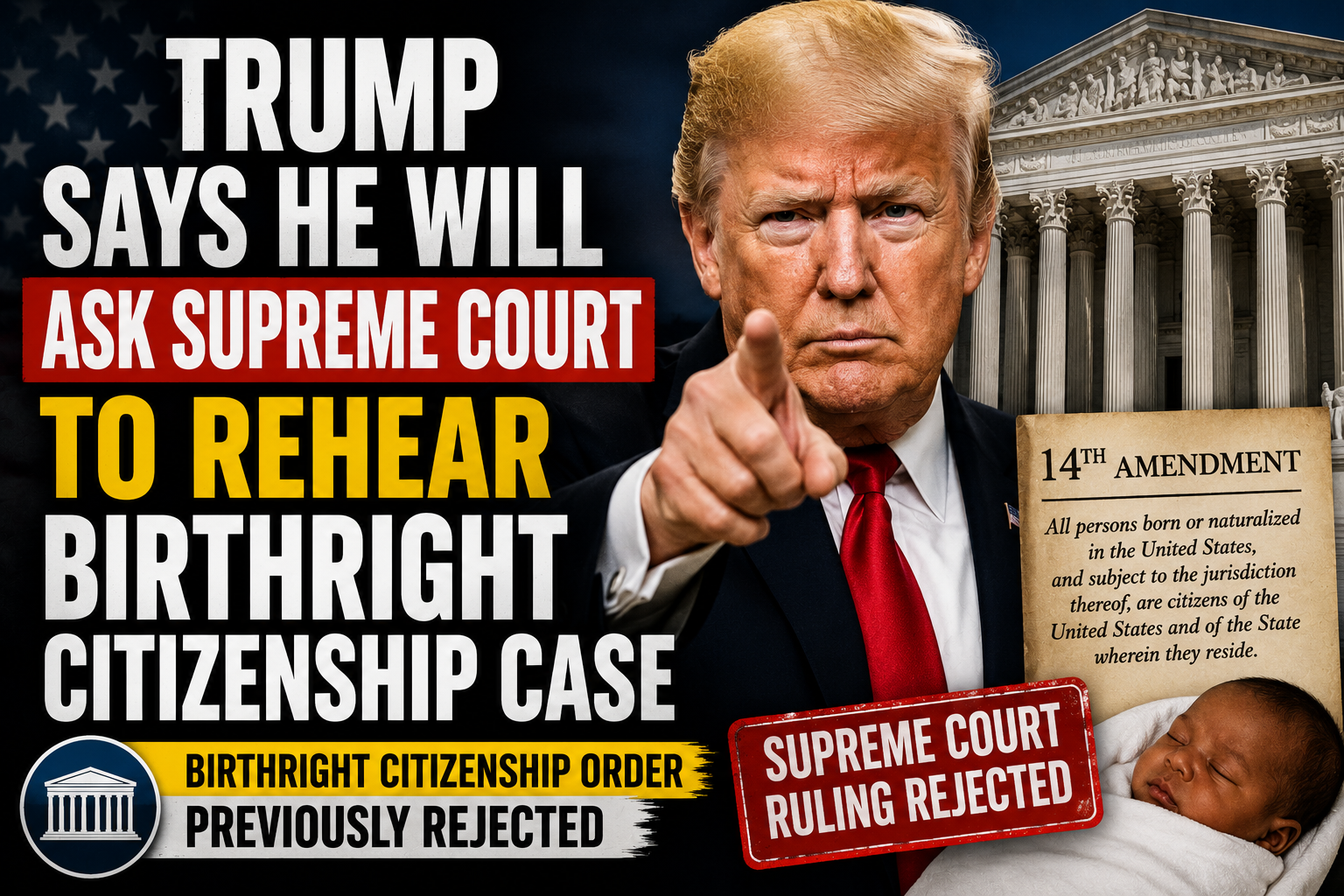
By Black Independent Media Network
President Donald Trump says he plans to ask the U.S. Supreme Court to reconsider its recent decision rejecting his effort to restrict birthright citizenship, renewing a legal fight over one of the most controversial immigration policies of his presidency.
The announcement comes after the nation’s highest court ruled that Trump’s executive order conflicts with the 14th Amendment of the U.S. Constitution, which guarantees citizenship to most people born on American soil.
On Wednesday, Trump announced on his social media platform, Truth Social, that he intends to seek a rehearing of the case, calling the Court’s decision legally flawed.
“AMERICAN CITIZENSHIP IS NOT FOR SALE! In fact, that is a crime, and therefore, the Supreme Court’s ruling is wrong. I will be asking for a Rehearing by the United States Supreme Court, IMMEDIATELY.”
Trump criticized the ruling, which was authored by Chief Justice John Roberts, describing it as a “miscarriage of justice.”
Last month, the Supreme Court rejected Trump’s attempt to limit birthright citizenship, finding that his executive order conflicted with the language of the 14th Amendment, which grants citizenship to individuals born in the United States who are “subject to the jurisdiction thereof.”
Birthright citizenship has been recognized in the United States for more than a century and has been upheld through longstanding constitutional interpretation.

While Trump says he will seek a rehearing, legal experts note that the Supreme Court rarely agrees to rehear cases after issuing a final decision. According to Reuters, the Court has not granted a rehearing in a fully argued case in decades, making such requests exceptionally uncommon.
If the request is filed, the justices would first decide whether to reconsider the case before addressing the underlying constitutional issues again.
Trump signed the executive order targeting birthright citizenship on his first day back in office as part of a broader immigration agenda aimed at tightening both legal and illegal immigration policies.
The proposal quickly faced multiple legal challenges from states, advocacy organizations, and constitutional scholars, who argued that a president cannot alter constitutional protections through executive action alone.
Supporters of the policy argue that birthright citizenship encourages misuse of the immigration system and should be reexamined. Opponents contend that changing the policy would require a constitutional amendment or a significant shift in Supreme Court precedent.
Trump’s expected request for a rehearing is likely to face long odds, given the Supreme Court’s longstanding practice of rarely revisiting decided cases. Even so, the move keeps the issue of birthright citizenship at the forefront of the national debate over immigration and constitutional law.
For now, the Supreme Court’s ruling remains in effect, and birthright citizenship continues to be governed by the existing interpretation of the 14th Amendment.
What do you think? Should birthright citizenship remain protected under the Constitution as it has for generations, or should the policy be revisited? Share your thoughts in the comments.